You have used ChatGPT or Claude. You have maybe pasted a long prompt into a model and gotten a useful answer. You are now curious: how do you actually build with these things?
This book is for you. It takes you from your first structured prompt to your first multi-agent system, in five compounding layers. No prior engineering background is required — but the book does not talk down. By the end, you will understand the architecture behind every modern AI product, and you will be able to design one of your own.
Five chapters across four Parts. Each chapter runs the same eight-part engine:
Orient (the question) → Prime (new terms) → Build (the explanation) → Show (worked example) → Fade (you try it) → Check Yourself (recall) → Recap (altitude) → Glossary (terms).
If you only skim, skim the navy BOTTOM LINE strip at the top of each chapter. That alone gives you the spine.
Two commitments you can hold the book to:
1. Small chunks. Each section introduces only a few ideas at a time.
2. You will be quizzed — gently. The CHECK YOURSELF boxes ask you to recall before reading on; the answers are right below, meant to be covered.
Every factual claim carries a tag, like a backtest with IS vs OOS labels:
V Verified — checked against a primary source (paper, official doc, or this machine's settings).
B Background — an established fact stated without a fresh citation.
SCHEMATIC Schematic — an illustrative diagram or synthetic example. The shape is real; the numbers are teaching.
Part A — Prompt Engineering. The first layer. The single most important skill in AI is talking to a model in a way it can act on. We cover the anatomy of a prompt, the five canonical patterns (zero-shot, few-shot, chain-of-thought, ReAct, tree-of-thoughts), and when each one breaks.
Part B · Building Blocks. The next two layers. Skills package a recurring task as a reusable block. Agents turn skills into autonomous workers that decide what to call and when.
Part C · The Engines. Loop engineering externalises iteration: a loop is a primitive that knows how to terminate, dedupe, and write evidence. We borrow Karpathy's 700-experiment autoresearch loop as a concrete case.
Part D · The Whole. Graph engineering externalises shared memory: the knowledge graph of facts, the commit DAG of work, the agent graph of who is allowed to do what. This is where multi-agent systems stop leaking context and start being inspectable.
Close. The verdict in one sentence, plus the path from one prompt to an engineered system.
Part A. Prompt Engineering
Before any system, there is a conversation. This Part builds the vocabulary for talking to a language model, then enumerates the five prompt patterns you will use for the rest of the book. By the end you should be able to look at any modern AI product and identify which pattern — or which combination of patterns — its prompts are using.
Chapter 1. The anatomy of a prompt
After this chapter you will be able to:
- Name the five layers of a prompt and what each one prevents.
- Distinguish prompts from conversations and pipelines.
- Write a prompt with all five layers correctly applied.
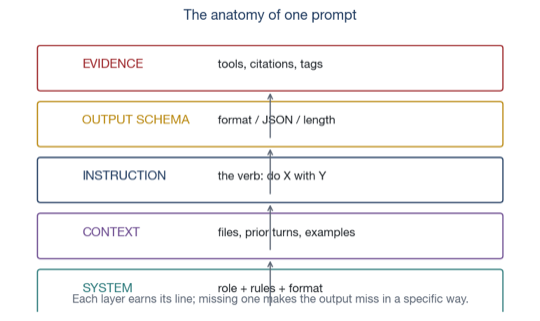
1.1 What a prompt actually is
- System layer: the rules and persona — ‘you are a senior analyst, always cite your sources’.
- Context layer: the files, prior turns, and examples the model can see.
- Instruction layer: the verb — ‘summarise’, ‘compare’, ‘extract’.
- Output schema: the format the answer must take — JSON, markdown table, two paragraphs, length cap.
- Evidence layer: tools, citations, or tags that make the answer verifiable.
Almost every prompt you have ever seen is missing the output schema SCHEMATIC. The model returns a paragraph where you wanted a table, or a bullet list where you wanted JSON. Adding ‘respond in JSON with keys summary, confidence, and source’ raises pass rates by tens of percent B — it is the single highest-leverage habit in the foundation layer.
1.2 Prompts are programs, not conversations
- Meta-prompt: a prompt that asks the model to design a better prompt for the same task.
- Prompt program: a structured prompt that lives in a file and is reused by other systems.
- program.md: Karpathy's name for a prompt-program file that scripts an autonomous research loop.
The 2024 'Building Effective Agents' essay from Anthropic B draws the same line: even a single prompt can be a compound AI system if it iterates with itself before returning. Prompts are no longer chat; they are the smallest deployable unit in modern AI work.
1.3 Common mistakes at the foundation layer
Three mistakes recur in nearly every beginner's prompts:
1. Vague verbs. ‘Tell me about’ produces survey essays. ‘Compare and contrast A vs B across three dimensions’ produces structured comparison. The verb does most of the work.
2. Missing output schema. As above. Always pin the shape SCHEMATIC.
3. Missing evidence layer. A confident answer with no source is the most expensive artefact in any AI product; it will fail in production the moment any user checks it. Add ‘if you do not know, say so and explain what you would check’ B.
From memory, before you read on:
- Name the five layers of a prompt in stacking order.
- What is the single highest-leverage habit in the foundation layer?
- What are the three most common beginner mistakes?
- A prompt is five stacked layers; missing one fails predictably.
- Prompts are programs: structured, reusable, and composable.
- The verb carries the meaning; the schema carries the structure.
- Evidence turns confidence into verifiability.
Part B. Skills and Agents
Once you can write a single prompt that does one thing well, the next question is: how do you reuse it? Two compounding patterns answer this. A skill packages a recurring task as a named, reusable block. An agent turns a skill into a worker that decides what to call and when. This Part covers both, in that order, and shows the moment the pattern graduates from ‘helpful script’ to ‘system’.
Chapter 2. Skills: packaging recurring work
After this chapter you will be able to:
- Define a skill in five parts.
- Read a SKILL.md frontmatter and identify what each field controls.
- Decide when to make a skill versus reuse an existing one.
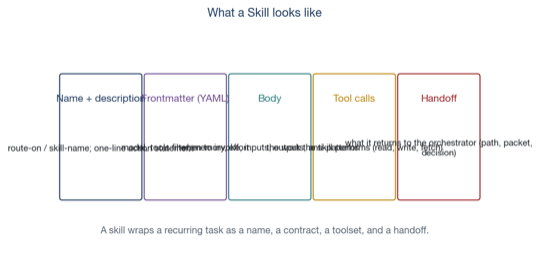
2.1 What a skill is
- Name: the stable identifier; matches the file name (SKILL.md) and any /command.
- Description: one-line action statement; it is also the routing hint for the orchestrator.
- Frontmatter (YAML): model, tools filter, memory scope, effort.
- Body: when to invoke, inputs, outputs, anti-patterns, example.
- Handoff: what the skill returns to its caller — path, packet, or decision.
The five parts look like ceremony, but each one prevents a different failure mode. The name prevents two skills from doing the same thing under different labels. The description prevents the orchestrator from routing to the wrong skill. The frontmatter prevents the skill from calling tools it should not have, or running on the cheapest model when it needs the most expensive one. The body prevents ad-hoc behaviour. The handoff prevents the caller from having to parse free-form prose.
2.2 SKILL.md frontmatter, field by field
---
name: trade-ticket-format
description: Convert a verbal trade idea into a structured ticket; never execute.
model: sonnet
tools: Read, Grep, Glob
memory: project
effort: low
---

You are a trade-ticket formatter. ...
Inputs:  a verbal trade idea (1-3 sentences).
Outputs: a JSON packet with keys symbol, direction, size, stop, target, confidence.
Each field is doing real work. model routes the skill to the right cost tier — haiku for mechanical, sonnet for assembly, opus for judgment. tools is the deny-by-default filter: anything not in the list is forbidden. memory controls whether the skill persists state across sessions. effort controls how much the model deliberates per turn.
Two rules of thumb that go with the frontmatter. First: never set memory without a reason — a persistent memory directory is a maintenance and security surface, so the default is none. Second: the description field is the routing hint — write it the way you would write a commit message: one line, specific, no fluff B.
2.3 Skills compose, do not replace each other
Two common beginner traps:
Trap 1: mega-skills. A skill that does the work of six smaller skills. Mega-skills are unreviewable, untestable, and impossible to compose with other skills. Resist.
Trap 2: one-call skills. A skill that wraps a single well-known prompt with no frontmatter value. It bloats the registry without adding anything. Skip it — call the model directly.
The sweet spot is a skill per recurring task type: a single verb, a clear handoff, three to seven frontmatter fields of real work. Most real-world skill libraries ship with 5-15 such skills, not 50 SCHEMATIC.
From memory, before you read on:
- Name the five parts of a skill.
- What does each frontmatter field control?
- What is the recommended library size for a skill registry?
- A skill is a named, structured package; not ‘a clever prompt’.
- Frontmatter is the contract; under-using it is the most common skill mistake.
- Mega-skills and one-call skills are both traps.
- Aim for 5-15 well-shaped skills per library.
Chapter 3. Agents: autonomous workers
After this chapter you will be able to:
- Define an agent versus a skill versus a pipeline.
- Identify the agent loop: sense, decide, act, repeat.
- Decide when an agent is the right pattern versus a fixed pipeline.
3.1 Agent vs pipeline
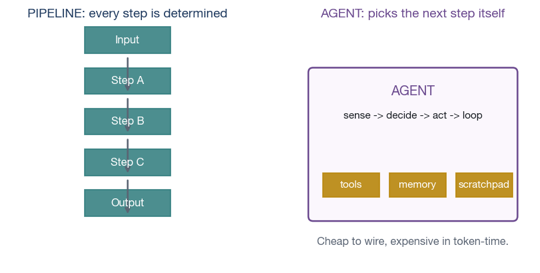
- Pipeline: deterministic sequence of steps; cheap, predictable, brittle to changes.
- Agent: autonomous worker that picks the next step; expensive, flexible, hard to test.
- Sub-agent: an agent invoked by another agent or an orchestrator, with a scoped context.
Pipeline first, agent second. The Anthropic 2024 essay B draws the same line: 'prefer the simplest, most composable pattern'. Most beginner systems over-use agents because the idea of an autonomous worker is more exciting than a deterministic sequence. The discipline is: when the steps are stable and the outputs are predictable, run a pipeline. When the steps depend on the inputs in ways no one wants to enumerate, run an agent.
3.2 The agent loop
- Sense: read the current state (memory, tools, last result, latest message).
- Decide: pick the next action (call a tool, write a memory, return a result).
- Act: execute the chosen action.
- Observe: process the result; update state; either continue or terminate.
ReAct B (Yao et al., 2022, arXiv:2210.03629) named the loop and gave it a paper. Modern agents still run it, with two additions: memory lets the loop persist state, and a terminal condition lets the loop end cleanly. Both are pieces we pick up in the next chapter on loops.
3.3 Sub-agents and the orchestrator
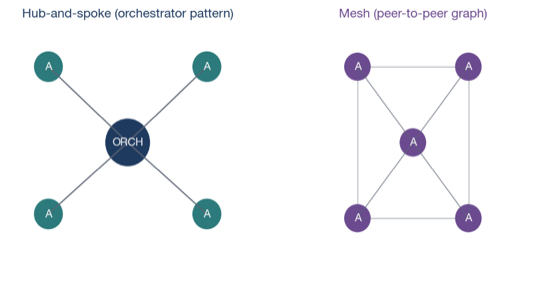
One agent with a 1M-token context window can hold a lot; it cannot hold everything. Sub-agents are the pattern: a top-level agent (the orchestrator) delegates scoped tasks to children, each of which has its own context and toolset.
Anthropic's 2026 Dynamic Workflows documentation B describes the production version of this pattern: up to 16 concurrent sub-agents per workflow, a hard cap of 1,000 per workflow, fresh context for each sub-agent, intermediate state in script variables, triggers via :workflow or ultracode mode, and the Bun runtime supporting roughly 750,000 lines of Zig in Rust in 11 days with 99.8% test pass rate V — concrete numbers from the published documentation.
The cardinal rule: the orchestrator's context must stay thin. If the orchestrator is quoting tool results from the last five turns, it has leaked sub-agent state into its own window and is about to lose the thread. Sub-agents return paths and typed packets; the orchestrator carries decisions and references, not data.
From memory, before you read on:
- What four steps does every agent loop run?
- Pipeline versus agent — when do you choose which?
- What is the cardinal rule for sub-agent orchestration?
- Pipeline first, agent second. Most beginners over-use agents.
- The agent loop is sense-decide-act-observe; everything else scales this.
- Sub-agents exist for isolation: failures stay local; transcripts stay cold.
- The orchestrator carries decisions; sub-agents carry detail.
Part C. Loop Engineering
Agents can run forever, in theory. In practice, the question is: how do they know when to stop? The answer is a discipline we call loop engineering. A loop is a primitive that knows how to terminate safely, dedupe its own work, write evidence, and report an after-action review. Once you have loop primitives, agents stop being toys and start being infrastructure.
Chapter 4. Loop engineering: the 5-must-have primitive
After this chapter you will be able to:
- State the 5-must-have contract.
- Write a loop that satisfies all five.
- Read a loop's AAR and decide whether it converged.
4.1 Where Karpathy's autoresearch came from
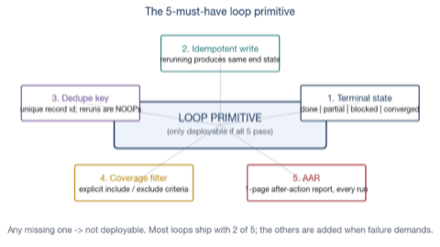
- Loop: a primitive that runs an inner experiment, evaluates it against a rubric, keeps or reverts, and continues.
- Terminal state: the loop's exit code: done | partial | blocked | converged.
- Idempotent write: running the loop twice produces the same end state, not two divergent copies.
- Dedupe key: a unique identifier for each record; reruns become NOOPs, not duplicates.
- Coverage filter: explicit include/exclude criteria so you know what was not covered.
- AAR (after-action report): a 1-page record written at terminal state: goal, decomposition, evidence, critique.
The autoresearch repository B reports that the agent edits train.py, evaluates with val_bpb, and either keeps or reverts the change with git reset. The pattern is exact: bounded change, measurable evaluation, reversibility, durable history V. Every production-grade loop has those four properties; the 5-must-have contract adds a fifth: terminal-state reporting, so a human can audit the run after the fact.
4.2 The 5-must-have contract
The contract is short and load-bearing:
1. Terminal state. Every loop ends in done | partial | blocked | converged. No ‘still running’.
2. Idempotent write. Running the loop twice with the same inputs and the same environment produces the same end state.
3. Dedupe key. Every record the loop writes has a unique key. Reruns of the same key are NOOPs.
4. Coverage filter. The loop declares what it covers and what it does not. The AAR reports both.
5. AAR. At terminal state, the loop writes a 1-page report: goal, decomposition, cost, evidence, critique, next run.
Most loops ship with the first two and ignore the rest. The cost is silent: the loop runs forever, fills disk with duplicates, never reports what it tried and what it skipped, and leaves no audit trail SCHEMATIC. The 5-must-have contract is cheap insurance against all of those failure modes.
def ratchet_loop(inspect, propose, apply, evaluate,
                 keep, revert, better, baseline):
    history, current = [], baseline
    while True:
        state = inspect()
        change = propose(state)
        commit = apply(change)
        try:
            score = evaluate()
        except Exception as exc:
            revert(commit)
            history.append(Trial(commit, change, None, "crash", ""))
            continue
        if better(score, current):
            keep(commit); current = score
            history.append(Trial(commit, change, score, "kept", ""))
        else:
            revert(commit)
            history.append(Trial(commit, change, score, "reverted", ""))

# caller MUST check terminal state, idempotent write, dedupe key,
# coverage filter, and write an AAR before this loop is deployable.
4.3 The five failures when one is missing
Each of the five must-haves prevents a specific, common failure:
Missing terminal state. The loop runs forever; bills rack up; the orchestrator cannot tell whether it finished.
Missing idempotent write. Two runs produce two divergent copies of the same artefact. Merge hell.
Missing dedupe key. Records multiply; storage costs balloon; downstream queries get confused.
Missing coverage filter. The loop covers half of what was asked; no one notices; the user re-runs the loop ten times to discover the gap.
Missing AAR. The loop terminates with no record of what it tried, what worked, what crashed, or what to try next. The next run starts from zero.
From memory, before you read on:
- Name the 5-must-have requirements.
- What does each one prevent?
- Which two are usually kept; which three are usually dropped?
- A loop is a primitive that iterates with bounded change, measurable evaluation, and reversibility.
- The 5-must-have contract is short and load-bearing.
- Each must-have prevents a specific, common failure.
- A 30-line script can satisfy the contract. A 300-line script that omits it is fragile.
Part D. Graph Engineering
Loops let agents iterate without runaway. Skills let them reuse work. What neither solves is the last piece of the puzzle: how do agents share knowledge across runs, across agents, and across models? The answer is graphs. This Part covers the four kinds of graphs inside AI, the decision framework for choosing one, and a staged build path from a single measured loop to a graph-grounded swarm.
Chapter 5. Graph engineering: the integrating layer
After this chapter you will be able to:
- Name the four kinds of graphs inside AI.
- Apply the 6-question decision framework to choose the right architecture.
- Read a commit DAG and a knowledge graph side by side.
5.1 Four kinds of graphs inside AI
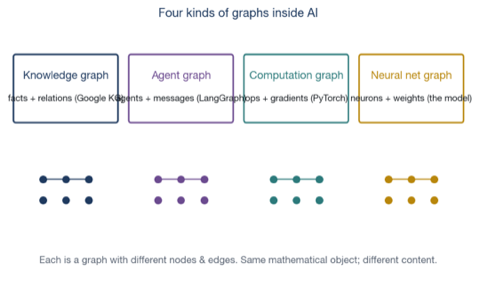
- Knowledge graph: typed entities as nodes, typed relations as edges; persistent, queryable.
- Agent graph: agents as nodes, messages or tool calls as edges; live topology, scoped lifetime.
- Computation graph: ops as nodes, data flow as edges; built and torn down per forward pass.
- Neural network graph: neurons as nodes, weights as edges; the parameters of the model itself.
Three of these are about memory (knowledge, agent, computation); one is about the substrate (the neural net). The graph-engineering layer focuses on the first three, because those are the ones the engineer builds.
5.2 The Karpathy loop → AgentHub → Anthropic playbook
The progression identified by the 2026 Anthropic playbook B is strikingly consistent. Stage 1 is a single loop that runs bounded experiments with measurable evaluation. Stage 2 is a swarm — many independent workers, each running the same loop, coordinated through a commit DAG and a message board (Karpathy's AgentHub is exactly this). Stage 3 is a knowledge graph that externalises shared memory: entities, relations, sources, lineage.
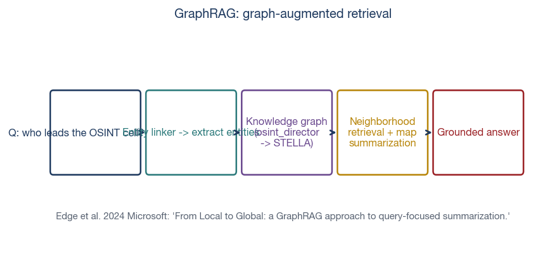
Anthropic's Knowledge Graph Construction Cookbook B operationalises stage 3 with a four-step pipeline: extract entities with Haiku, resolve aliases with Sonnet, assemble with NetworkX MultiDiGraph, and query by serialising subgraphs. The cookbook warns about the most common failure: entity resolution can cause catastrophic errors — a false merge between two people with similar names propagates downstream. Resolution must be additive, inspectable, and reversible.
5.3 The 6-question decision framework
The same playbook offers a six-question framework for choosing an architecture. Answer each question; the answers map to a pattern:
| Question | If yes, use |
|---|---|
| 1. Can success be verified? | if no, you cannot use autonomy at all |
| 2. Are the steps stable? | chain (prompt chaining) |
| 3. Are subtasks independent? | parallel (parallelization) |
| 4. Must alternative lineages remain? | DAG (commit DAG of work) |
| 5. Must facts survive the run? | knowledge graph |
| 6. Can the org afford the cost + latency? | set budgets before adding workers |
Question 1 is the most important: if you cannot define what success looks like, do not begin with autonomy. A loop that runs unbounded on an unverifiable task is a fast path to expensive noise. The other five questions build on that first answer.
5.4 The Commit DAG and Knowledge Graph are complementary
- Commit DAG: a directed acyclic graph of work; parent links are the edges; commits are the nodes.
- Knowledge graph: a typed entity-relation graph; entities are the nodes; relations are the edges.
- Shared memory: the role a knowledge graph plays when many agents need to read the same facts.
The Anthropic playbook V summarises this with one sentence: the DAG remembers which work descends from which experiment; the graph remembers which claims connect to which entities and sources. Together they prevent agents from rebuilding the world from scratch in every context window.
Production systems connect the two: every write to the commit DAG includes a link to a claim in the knowledge graph, and every claim in the graph includes a link to the agent run that produced it. The compound structure becomes queryable in both directions: ‘show me the lineage of this experiment’ and ‘show me what produced this fact’ are the same question in two forms.
5.5 When NOT to use a graph
Graphs are not free. The playbook B lists the cases where a graph is the wrong tool: tasks are independent; answers depend on one document; relations are fixed and simple; a relational table answers every query; or extraction errors would outweigh traversal value.
Three more costs to weigh:
Dynamic workflows are expensive. A 1,000-sub-agent run at high effort can cost tens of dollars per task. Parallel workers create correlated errors; the verification wave is the only thing that catches them.
Fragmentation can reduce quality. Architecture design, narrative writing, and tightly coupled refactors may degrade when split into isolated units.
Knowledge graphs reflect their corpus. A biased corpus produces a biased graph; missing documents produce missing edges.
The discipline is: introduce a graph when at least one of questions 4 or 5 is yes. Otherwise stay with loops and skills.
From memory, before you read on:
- Name the four kinds of graphs inside AI.
- What does each of the 6 questions map to?
- When does a graph earn its place?
- Four kinds of graphs inside AI; only three are built by the engineer.
- Progression: loop → swarm → graph. Each stage externalises a different bottleneck.
- The 6-question framework maps decisions to patterns.
- Commit DAG + knowledge graph are complementary, not collapsible.
- Graphs are not free — only adopt when the answer to Q4 or Q5 is yes.
Chapter 6. Operating the stack: cost, observability, scaling
After this chapter you will be able to:
- Read a token budget and a cost-per-task number without flinching.
- Wire observability into a multi-agent system.
- Decide when to scale up, when to scale out, and when to do neither.
- Name the three most expensive anti-patterns in production AI.
6.1 The four dials
- Cost: USD (or equivalent) per unit of work; for AI it is tokens x $/Mtoken.
- Latency: seconds from input to first useful output; for AI it is the slow path of the slowest sub-agent.
- Quality: pass rate against a held-out rubric; for AI it is M9 first-pass acceptance.
- Throughput: tasks per hour under budget; for AI it is parallelism x quality.
The Anthropic Dynamic Workflows docs B report that a 1,000-sub-agent workflow with high-effort reasoning can cost tens of dollars per task at the top model tier. That is a useful upper bound: if your design admits a 1,000-sub-agent run, you must be ready to spend that much per task SCHEMATIC. The cheapest fix is almost always route to the smallest model that can solve the task, not average out with cheaper tools.
6.2 Observability what to log
Three things must be on every agent run log:
Inputs and outputs. Hash the input. Hash the final output. Store both with the run id. Without these you cannot reproduce a failure or measure drift.
The agent graph at run time. Which skills were invoked, in what order, with what arguments, returning what. This is the agent graph as telemetry SCHEMATIC. Most teams under-invest here.
The verification wave. Whatever review step catches errors. Did it catch a wrong answer? How many times? What was the false-positive rate?
6.3 The three most expensive anti-patterns
Three patterns recur in production AI failures. Each one wastes budget or produces unreliable output:
1. Mega-skills. A skill that does the work of ten. Reviewer cannot audit; output cannot be partial. Fix: split by task type.
2. Long-context as memory. Stuffing state into the prompt instead of writing to disk. Costs scale linearly with context size; quality falls non-linearly. Fix: offline-first files, references by path.
3. Aggressive parallelism without a reducer. 16 sub-agents returning uncorrelated outputs. The synthesis step becomes a guessing game. Fix: the agent-graph telemetry tells you whether the workers agree before they merge.
From memory, before you read on:
- Name the four operational dials.
- What three things must be on every agent run log?
- What is the cheapest fix when a 1,000-sub-agent run costs too much?
- Four dials: cost, latency, quality, throughput. Operate them together.
- Observability = hashed inputs, agent graph, verification wave.
- Three expensive anti-patterns: mega-skills, long-context memory, parallelism without a reducer.
- Scale up only after the cheap levers are exhausted.
Part •. Where This Leaves Us
The verdict in one sentence: a modern AI system is a stack of five compounding layers — prompts, skills, agents, loops, graphs — and the difference between a toy and an engineered system is that each layer satisfies its own contract: a prompt has five layers; a skill has a five-part package; an agent runs the four-step loop; a loop satisfies the 5-must-have contract; a graph earns its place only when alternative lineages or persistent facts demand it.
The progression in three steps. Karpathy named it cleanly: vibe coding (the human writes everything), agentic engineering (the human specifies, orchestrates, verifies), and graph engineering (agents share typed, queryable graphs of work and knowledge). The single most important insight: the bottleneck is often not the next model call. It is the placement of memory and evaluation.
The evidence base. This workbook is grounded in three primary sources on this machine. V The July-2026 synthesis Graph Engineering: The Karpathy Loop, Improved 1000x by Itself — The Anthropic Playbook (see the synthesized reference; cites Karpathy's autoresearch, his AgentHub, Anthropic's Building Effective Agents, Anthropic's Dynamic Workflows, and the Anthropic Knowledge Graph Construction Cookbook). B Karpathy's autoresearch repository (March 2026 — 700-line loop, ~700 experiments, ~20 retained). B The Wei et al. chain-of-thought paper (2022, arXiv:2201.11903). All other numerical figures are illustrative (SCHEMATIC).
The closing principle. A reliable graph-engineering system satisfies one rule: every important output can be traced to an objective, a plan, an artifact, a source, a graph path, an evaluator decision, and a bounded execution record. When that statement is false, adding more agents, loops, swarms, DAGs, or graphs increases opacity instead of reducing it. Begin with the smallest pattern that solves the task; the progression will tell you when to add the next layer.