Anyone who needs an LLM to reason across many documents, many agents, or both. You do not need a math background. If you have ever pasted a stack of papers into a chatbot and watched it quietly lose the connection between them, this book is for you.
It is also for the engineer who's tired of being told “just put it in the context” and the PM who's tired of vector-search demos that fall apart on the third question.
Seven chapters in three parts.
Part A · Why. Chapters 1–2 set up the 290-year-old idea and name the modern problem it solves.
Part B · How. Chapters 3–5 walk through anatomy, the four-stage pipeline, and the shared-memory pattern.
Part C · Where. Chapters 6–7 match the graph to the five agent patterns Anthropic ships and give you a ten-item production checklist.
Read top to bottom, or jump to Part C if you just want to know whether to build one.
Every figure in this book carries a chip in the corner.
V = verified against a primary source.
B = background context.
SCHEMATIC = schematic / illustrative.
Treat the spine as load-bearing; treat the numbers as anchors for the idea, not as gospel.
1. The seven bridges of Königsberg
2. Why context windows are not enough
Part B · How
3. Anatomy of a knowledge graph
4. The four-stage pipeline
5. The shared-memory pattern
Part C · Where
6. Five agent patterns, five graph roles
7. Building & shipping a graph that holds up
Part A. WHY GRAPHS
Chapter 1. The seven bridges of Königsberg
After this chapter you will be able to:
- Name what a graph is, in one sentence.
- Recognize a graph when you see one — in code, in conversation, in your own notes.
- Spot the moment a list of facts stops being enough.
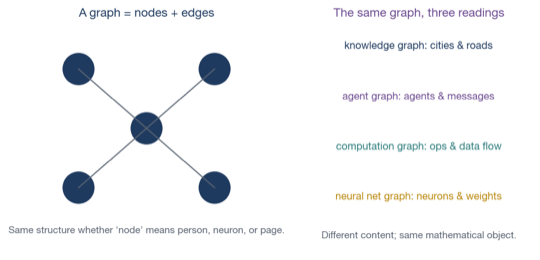
- Two lists and a rule: A graph is two lists and a rule. List one is the vertices: the things. List two is the edges: the relationships. The rule says which things connect to which.
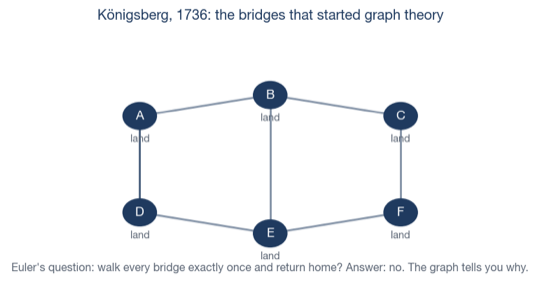
Edges are the relationships. In conversation they might be 'works on', 'depends on', 'was acquired by', 'contradicts'. In code they are the rows of another database — the ones with two foreign keys.
The rule is just the schema: what types of vertices are allowed, what types of edges, and what attributes each one carries.
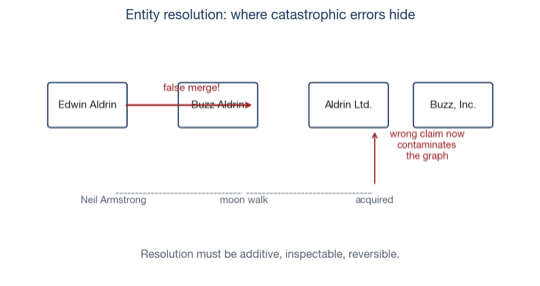
If two of your projects have the same helper, the helper is in the graph twice — but they are the same person. That's the resolution problem we'll meet in chapter 4. If your edge “uses” points at different tools for different projects, you have already invented a predicate vocabulary — also chapter 4.
From memory, before you read on:
- Y
- o
- u
- h
- a
- v
- e
- a
- l
- i
- s
- t
- o
- f
- 1
- 0
- 0
- c
- o
- m
- p
- a
- n
- i
- e
- s
- a
- n
- d
- a
- l
- i
- s
- t
- o
- f
- 1
- 0
- 0
- 0
- a
- c
- q
- u
- i
- s
- i
- t
- i
- o
- n
- s
- .
- T
- h
- e
- a
- c
- q
- u
- i
- s
- i
- t
- i
- o
- n
- s
- s
- a
- y
- '
- A
- c
- m
- e
- b
- o
- u
- g
- h
- t
- B
- e
- t
- a
- '
- .
- W
- h
- a
- t
- d
- o
- v
- e
- r
- t
- i
- c
- e
- s
- a
- n
- d
- e
- d
- g
- e
- s
- l
- o
- o
- k
- l
- i
- k
- e
- ?
- A graph is two lists and a rule: vertices, edges, schema.
- Euler's 1736 walk through Königsberg invented the picture; the data model is the same 290 years later.
- Draw the graph last. Build the data first.
Chapter 2. Why context windows are not enough
After this chapter you will be able to:
- Explain why a model with a million-token context window still loses to a 200-line graph.
- Identify the failure mode where summarization gives you a confident wrong answer.
- State the rule of thumb for when to invest in a graph.
- Memory, not intelligence: The bottleneck is memory. Ask an LLM five questions about a 200-page document. The first answer uses pages 1-200. The second answer uses your question + pages 1-200, minus whatever the model truncated to make room. By the fifth question, 'pages 1-200' is a memory of a memory of a memory. Faithfulness drops with each hop.
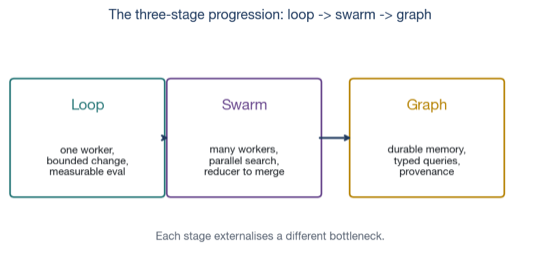
Agentic engineering fails on composition — five agents each summarize; their summaries don't link.
Graph engineering works — the graph is the durable layer that survives every context-window flush.
From memory, before you read on:
- Y
- o
- u
- h
- a
- v
- e
- o
- n
- e
- a
- n
- a
- l
- y
- s
- t
- a
- g
- e
- n
- t
- a
- n
- d
- o
- n
- e
- r
- e
- p
- o
- r
- t
- a
- g
- e
- n
- t
- .
- T
- h
- e
- a
- n
- a
- l
- y
- s
- t
- r
- e
- a
- d
- s
- 5
- 0
- f
- i
- l
- i
- n
- g
- s
- ,
- t
- h
- e
- r
- e
- p
- o
- r
- t
- w
- r
- i
- t
- e
- s
- a
- s
- u
- m
- m
- a
- r
- y
- .
- E
- v
- e
- r
- y
- m
- o
- r
- n
- i
- n
- g
- y
- o
- u
- w
- a
- n
- t
- a
- f
- r
- e
- s
- h
- s
- u
- m
- m
- a
- r
- y
- t
- h
- a
- t
- d
- r
- a
- w
- s
- o
- n
- t
- h
- e
- l
- a
- s
- t
- 9
- 0
- d
- a
- y
- s
- o
- f
- f
- i
- l
- i
- n
- g
- s
- &
- m
- d
- a
- s
- h
- ;
- n
- o
- t
- j
- u
- s
- t
- t
- o
- d
- a
- y
- '
- s
- .
- W
- h
- e
- r
- e
- d
- o
- e
- s
- t
- h
- e
- s
- h
- a
- r
- e
- d
- s
- t
- a
- t
- e
- l
- i
- v
- e
- ?
- The bottleneck is memory, not intelligence.
- Context windows die; files remember.
- A graph is the file format that lets agents share what they remember.
Part B. HOW
Chapter 3. Anatomy of a knowledge graph
After this chapter you will be able to:
- Name the three core layers of a knowledge graph.
- Read a graph triple out loud.
- Spot the four places naive graphs fail.
- Entities, relations, provenance: Every knowledge graph is made of three things. Entities are the things — people, projects, papers, drugs, filings, claims. Relations are the typed edges between them. Provenance is the document and paragraph each claim came from. Skip provenance and you have a rumor graph.
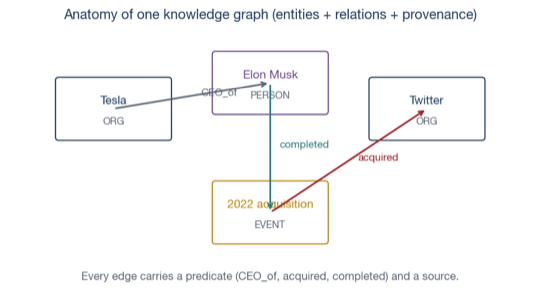
The relation. Has a source and target (both entity ids), a short verb-phrase predicate (works-on, contradicts, funded-by), and a back-reference to the source document.
The provenance. The document id, the paragraph offset, and the timestamp. Without this, claims are claims; with it, claims are evidence.
{
  "source": "agent:alpha_researcher",
  "predicate": "owns",
  "target": "finding:graph-engineering-cookbook",
  "provenance": {
    "doc_id": "Graph-Engineering-Athropic-Playbook.pdf#p2",
    "offset": "lines 14-19",
    "verified_at": "2026-07-26"
  }
}From memory, before you read on:
- Y
- o
- u
- w
- r
- i
- t
- e
- '
- A
- l
- i
- c
- e
- m
- a
- n
- a
- g
- e
- s
- B
- e
- t
- a
- '
- .
- W
- h
- i
- c
- h
- s
- i
- d
- e
- i
- s
- t
- h
- e
- s
- u
- b
- j
- e
- c
- t
- ,
- w
- h
- i
- c
- h
- s
- i
- d
- e
- i
- s
- t
- h
- e
- o
- b
- j
- e
- c
- t
- ,
- a
- n
- d
- w
- h
- e
- r
- e
- '
- s
- t
- h
- e
- p
- r
- o
- v
- e
- n
- a
- n
- c
- e
- ?
- Entities, relations, provenance. The whole schema in one line.
- The hard part is resolution — turning 'Alice', 'A. Smith', 'Alice Smith', and 'Alice B. Smith' into one canonical node.
- That's the next chapter.
Chapter 4. The four-stage pipeline
After this chapter you will be able to:
- Run the four stages by hand on a single document.
- Explain why resolution is where unsupervised graphs fail most often.
- Pick the right model per stage — Haiku for extraction, Sonnet for reasoning.
- One recipe, four stages: Stage 1. Read a document. Extract entities (PERSON, ORG, LOC, EVENT, ARTIFACT) and the typed relations between them. Return as a typed object, not free text.
Stage 2. Compare the new entities against the existing graph's alias map. Cluster any near-duplicates.
Stage 3. Rewrite the relations in terms of the canonical entity ids. Pool hub-node mentions and summarize.
Stage 4. At query time, take the user's question, extract its seed entity, walk 1–2 hops, hand the serialized triples to the answer model, and require every claim to cite a specific edge.
Resolve with a stronger model — only when needed. Block candidates by cheap signals (same last name, string overlap, embedding similarity). Send only ambiguous blocks (50-100 candidates) to a Sonnet-class model.
Assemble once. Every hub node (degree ≥ 3) gets a multi-paragraph profile pooled from every document that mentions it. Re-summarize only when the source-doc set changes.
Query per question. Walk k=2 hops from the question's seed entity, serialize the subgraph, hand it to the answer model, require a citation per claim. k=1 is fast but misses chains. k=3+ drowns the prompt.
from pydantic import BaseModel
from anthropic import Anthropic

class Entity(BaseModel):
    name: str
    type: str  # PERSON | ORG | LOC | EVENT | ARTIFACT
    description: str  # one-line, for resolution

def extract(client: Anthropic, text: str) -> list[Entity]:
    r = client.messages.parse(
        model="claude-haiku-4-5",
        max_tokens=2_048,
        messages=[{"role": "user",
                   "content": f"Extract entities from:\n{text}"}],
        output_format=list[Entity],
    )
return r.parsed_outputFrom memory, before you read on:
- Y
- o
- u
- h
- a
- v
- e
- 1
- 0
- ,
- 0
- 0
- 0
- d
- o
- c
- u
- m
- e
- n
- t
- s
- a
- v
- e
- r
- a
- g
- i
- n
- g
- 2
- ,
- 0
- 0
- 0
- t
- o
- k
- e
- n
- s
- e
- a
- c
- h
- .
- T
- h
- e
- e
- x
- t
- r
- a
- c
- t
- i
- o
- n
- s
- c
- h
- e
- m
- a
- i
- s
- s
- t
- a
- b
- l
- e
- .
- T
- h
- e
- d
- a
- y
- '
- s
- r
- e
- s
- o
- l
- u
- t
- i
- o
- n
- q
- u
- e
- u
- e
- i
- s
- e
- m
- p
- t
- y
- .
- W
- h
- a
- t
- '
- s
- t
- h
- e
- d
- o
- m
- i
- n
- a
- n
- t
- c
- o
- s
- t
- ?
- Extract, resolve, assemble, query. Each stage is a typed LLM call.
- The schema is the only training data you need.
- Run this on ten documents and you have a graph. Run it on ten thousand and you have infrastructure.
Chapter 5. The shared-memory pattern
After this chapter you will be able to:
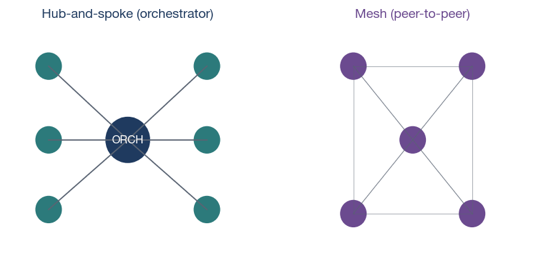
- Explain why orchestrator-workers bottleneck on context.
- Draw the message-board pattern that replaces the bottleneck.
- List the three rules that keep the shared memory from drifting.
- Replace summaries with a graph: Have each worker write entities and relations to a shared graph. The orchestrator's job is no longer to read summaries — it is to query the graph. The graph is the durable shared memory that survives every worker finishing. The orchestrator's context window stays small.
Rule 2: read with provenance. Every worker reads with an edge-level provenance trail. If the answer would have to invent an edge, refuse.
Rule 3: schema-enforce at write time. If the schema doesn't allow an entity type or a predicate, reject the write at the door. Schema drift is worse than no graph.
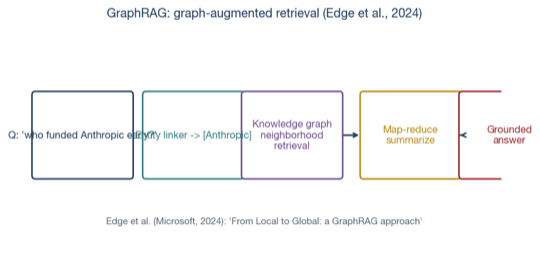
def ask(question, graph_context):
    prompt = f"""
Answer using ONLY the knowledge graph below.
Cite the specific edges that support your answer.


{graph_context}


Question: {question}"""
return call_model(prompt)From memory, before you read on:
- A
- n
- e
- v
- a
- l
- u
- a
- t
- o
- r
- a
- g
- e
- n
- t
- r
- e
- c
- e
- i
- v
- e
- s
- a
- g
- e
- n
- e
- r
- a
- t
- o
- r
- '
- s
- c
- l
- a
- i
- m
- .
- I
- t
- m
- u
- s
- t
- c
- h
- e
- c
- k
- t
- h
- e
- c
- l
- a
- i
- m
- a
- g
- a
- i
- n
- s
- t
- e
- x
- t
- r
- a
- c
- t
- e
- d
- f
- a
- c
- t
- s
- ,
- n
- o
- t
- e
- s
- t
- i
- m
- a
- t
- e
- d
- o
- n
- e
- s
- .
- W
- h
- a
- t
- '
- s
- t
- h
- e
- c
- h
- e
- a
- p
- e
- s
- t
- w
- a
- y
- t
- o
- w
- i
- r
- e
- t
- h
- a
- t
- ?
- Replace summaries with a graph.
- Workers write typed triples, the orchestrator queries the graph, the answer cites the edges.
- The graph is the shared memory. The schema is the trust boundary.
Part C. WHERE
Chapter 6. Five agent patterns, five graph roles
After this chapter you will be able to:
- Name the five agent patterns Anthropic publishes.
- Match each pattern to the role a graph plays in it.
- Recognize which pattern is which in the wild.
- Five patterns, one shared backbone: The patterns are: augmented LLM, prompt chaining, routing, orchestrator-workers, evaluator-optimizer. Below them the graph plays a different role each time — but it is the same graph.
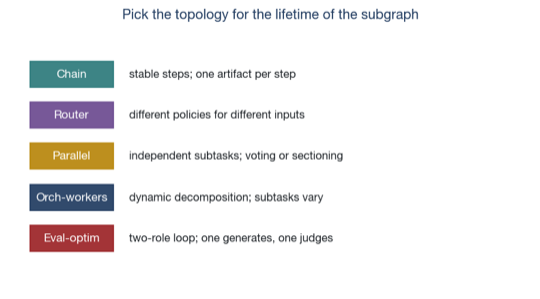
Prompt chaining. Graph role: gate signal. Between two chain steps, a graph query decides whether to branch. Use this when the chain is fragile and you want data-driven handoffs.
Routing. Graph role: classifier input. The router consults the graph to learn what kinds of inputs each specialist handles. Use this when specialists need to be added or removed without retraining a router model.
Orchestrator-workers. Graph role: shared memory. This is the chapter-5 pattern. Workers read and write the graph; the orchestrator queries it.
Evaluator-optimizer. Graph role: grounding layer. The evaluator checks the generator's claims against the graph's edges with provenance, not against model estimation.
From memory, before you read on:
- Y
- o
- u
- '
- r
- e
- b
- u
- i
- l
- d
- i
- n
- g
- '
- s
- e
- a
- r
- c
- h
- o
- v
- e
- r
- c
- o
- m
- p
- a
- n
- y
- f
- i
- l
- i
- n
- g
- s
- '
- .
- M
- o
- s
- t
- f
- i
- l
- i
- n
- g
- s
- a
- r
- e
- l
- o
- n
- g
- P
- D
- F
- s
- .
- T
- h
- e
- u
- s
- e
- r
- a
- s
- k
- s
- '
- w
- h
- a
- t
- d
- i
- d
- c
- o
- m
- p
- a
- n
- y
- X
- o
- w
- n
- i
- n
- Q
- 3
- 2
- 0
- 2
- 4
- ?
- '
- S
- i
- n
- g
- l
- e
- -
- h
- o
- p
- a
- n
- s
- w
- e
- r
- ,
- m
- u
- l
- t
- i
- -
- h
- o
- p
- q
- u
- e
- s
- t
- i
- o
- n
- .
- W
- h
- i
- c
- h
- p
- a
- t
- t
- e
- r
- n
- ?
- Five patterns, one graph. Each pattern consumes the graph differently.
- Each role is an upgrade to the pattern you already have — not a replacement.
Chapter 7. Building & shipping a graph that holds up
After this chapter you will be able to:
- List the ten production-readiness checks.
- Identify which failure each check prevents.
- Recognize which one you're missing when something breaks.
- Ten checks, before each ship: Gold set, alias map, schema version, extraction cap, resolution fallback, provenance tracking, incremental update, connectivity monitor, summarization trigger, human sample. Ten items. Run all ten. Don't ship without them.
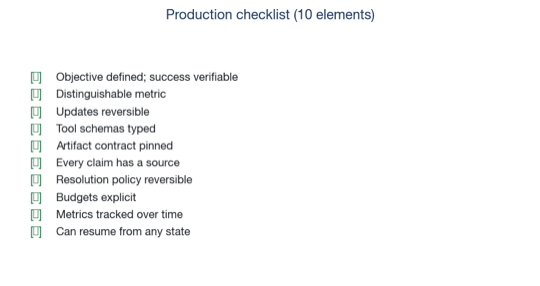
2. Alias map. Every canonical form a resolver might produce, matched to its surface variants. The cookbook shows the failure mode: 'Neil Alden Armstrong' resolves but the scorer doesn't recognize the gold form.
3. Schema version. A versioned file under version control, alongside the graph. Entities extracted under schema v1 must be re-extractable under schema v2.
4. Extraction cap. A per-run limit on documents processed. Unbounded cost is the silent failure of unsupervised pipelines.
5. Resolution fallback. Every raw name should land in exactly one cluster — including single-element clusters when no match exists. Silent entity loss is worse than false merges.
6. Provenance tracking. Every edge has a source document id, an extraction timestamp, and the entity-id pair that produced it.
7. Incremental update. New documents land at the edge of the graph; only changed hub nodes get re-summarized. Rebuilding the whole graph per doc is a cost cliff.
8. Connectivity monitor. Connected-component count per session. A growing number of components means resolution is failing somewhere.
9. Summarization trigger. Re-summarize only when the source-doc set for that entity changes. Ad-hoc triggers are wasted Sonnet calls.
10. Human sample. Someone reads one random node profile per day. Comprehension rot is the failure mode you can't catch programmatically.
From memory, before you read on:
- Y
- o
- u
- r
- g
- r
- a
- p
- h
- s
- h
- i
- p
- s
- .
- S
- i
- x
- w
- e
- e
- k
- s
- l
- a
- t
- e
- r
- t
- h
- e
- a
- n
- s
- w
- e
- r
- s
- a
- r
- e
- g
- e
- t
- t
- i
- n
- g
- w
- o
- r
- s
- e
- .
- T
- h
- e
- c
- a
- u
- s
- e
- i
- s
- t
- h
- e
- s
- o
- u
- r
- c
- e
- d
- o
- c
- u
- m
- e
- n
- t
- s
- s
- h
- i
- f
- t
- i
- n
- g
- u
- n
- d
- e
- r
- n
- e
- a
- t
- h
- t
- h
- e
- c
- a
- c
- h
- e
- d
- h
- u
- b
- -
- n
- o
- d
- e
- s
- u
- m
- m
- a
- r
- i
- e
- s
- .
- W
- h
- i
- c
- h
- c
- h
- e
- c
- k
- c
- a
- t
- c
- h
- e
- s
- i
- t
- ?
- Ten checks. Run all ten before each ship.
- Three groups: evaluation, silent-corruption guards, operational discipline.
- The evaluation harness, provenance tracking, and human sample are the judgment; everything else is infrastructure.
- A graph is two lists and a rule — vertices, edges, schema. That's all.
- Memory is the bottleneck. Context windows die; files remember. A graph is the file format that lets agents share what they remember.
- Every knowledge graph in production is built by four stages: extract, resolve, assemble, query. Each is a typed LLM call. The schema is the training data.
- The most useful graph in production is the one five agents can read and write at the same time without the orchestrator bottleneck.
- The graph plays five different roles in Anthropic's five agent patterns — but it is the same graph.
- Ten checks before each ship. The evaluation harness, provenance tracking, and human sample are the judgment; everything else is infrastructure.
Agentic engineering — orchestrated multi-step workflows with tools and skills. The orchestrator's context window is the fragile link.
Graph engineering — agents share a typed, queryable graph as their persistent world model. The graph is the layer that survives every context flush.
Companion volumes. AI Engineering from the Ground Up — the workbook this one grew out of.